Romeo and Juliet in Palestine by Tom Sperlinger
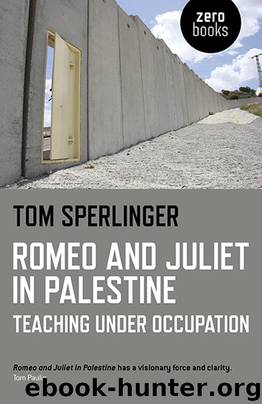
Author:Tom Sperlinger [Sperlinger, Tom]
Language: eng
Format: epub
ISBN: 978-1-78279-636-7
Publisher: Zero Books
Published: 2015-06-26T04:00:00+00:00
In each scene in ‘Seven Jewish Children’, a group of adults debates what a child should be told about an event that is unfolding, from the Nazi Holocaust to the 2008 bombing of Gaza. Most of the lines begin ‘Tell her’ or ‘Don’t tell her.’
There was a debate among the students about how many speakers the lines I had read should be divided between and whether the photograph would be projected on a screen behind the actors, so that the audience could see it. Ruqaya suggested that the students should write an additional scene, set in Gaza or the West Bank, which they could add on to the end of the play. ‘I want to show that we tell the truth to our children,’ she said. ‘We don’t lie.’ I was going to ask why someone might soften the truth for a child. But I could not find the right words and the moment passed.
Churchill’s play was controversial when it was first performed. The lawyer Anthony Julius’s reading of it is similar to Ruqaya’s. He sees it as part of a revival of anti-Semitism in England, and he characterises the message of the play as: ‘These Jews are liars. They abuse their own children by lying to them, in order to conceal their greater, more lethal abuse of Palestinian children.’ I had not read the play before, but I thought there was more to it than that.
The dilemma that is faced by the adults in the second conversation was a real one for my grandparents. Tibor and Lisl were able to leave Vienna in 1938 because Tibor had worked for a British firm and obtained a work permit to come to London. But Lisl’s mother, father and stepparents all died in concentration camps, along with many of their other relatives and friends. My father, growing up in the 1950s, knew that the Germans had killed members of his family, but it was rarely spoken about. There are accounts of a similar reluctance to talk about the Holocaust in other families. After the war, many survivors were traumatised by their experiences and some felt shame that the Jewish community had ‘allowed’ these events to happen. There was also no larger narrative: ‘the Holocaust’ only emerged as a recognised description in the 1960s (and today many in the Jewish community still use the biblical term shoah, meaning ‘the calamity’).
The philosopher Stanley Cavell has written about the difficulty of knowing, with any certainty, that I am in pain or that you are. He suggests that knowing someone is in pain is not a matter of certainty, but of sympathy:
But why is sympathy expressed in this way? Because your suffering makes a claim upon me. It is not enough that I know (am certain) that you suffer—I must do or reveal something (whatever can be done). In a word, I must acknowledge it, otherwise I do not know what “(you or his) being in pain” means.
Download
This site does not store any files on its server. We only index and link to content provided by other sites. Please contact the content providers to delete copyright contents if any and email us, we'll remove relevant links or contents immediately.
Waking Up in Heaven: A True Story of Brokenness, Heaven, and Life Again by McVea Crystal & Tresniowski Alex(37944)
Still Foolin’ ’Em by Billy Crystal(36491)
Cecilia; Or, Memoirs of an Heiress — Volume 1 by Fanny Burney(32746)
Cecilia; Or, Memoirs of an Heiress — Volume 2 by Fanny Burney(32108)
Cecilia; Or, Memoirs of an Heiress — Volume 3 by Fanny Burney(32089)
Fanny Burney by Claire Harman(26748)
Empire of the Sikhs by Patwant Singh(23219)
We're Going to Need More Wine by Gabrielle Union(19223)
Hans Sturm: A Soldier's Odyssey on the Eastern Front by Gordon Williamson(18735)
Plagued by Fire by Paul Hendrickson(17556)
Out of India by Michael Foss(17038)
All the Missing Girls by Megan Miranda(16814)
Cat's cradle by Kurt Vonnegut(15583)
For the Love of Europe by Rick Steves(14997)
Pimp by Iceberg Slim(14818)
Molly's Game by Molly Bloom(14281)
Bombshells: Glamour Girls of a Lifetime by Sullivan Steve(14240)
Leonardo da Vinci by Walter Isaacson(13543)
4 3 2 1: A Novel by Paul Auster(12638)
